Fighting for Our Lives
1975 | 59m | English
Popularity: 0.2 (history)
| Director: | Glen Pearcy |
|---|---|
| Writer: | Glen Pearcy, Peter Matthiessen, Luis Valdez |
| Staring: |
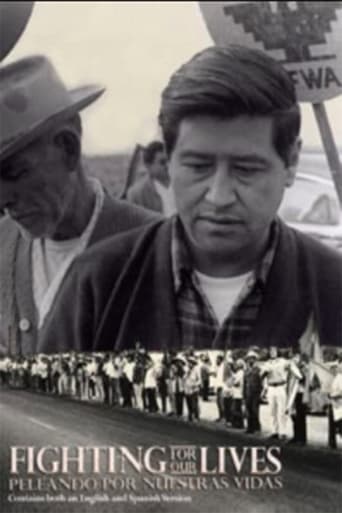
| Fighting for Our Lives is a 1975 documentary film produced and directed by Glen Pearcy. The film documents the striking of California grape workers from Coachella to Fresno as they negotiate for a United Farm Workers (UFW) contract in 1973. The film also depicts their non-violent struggle against police brutality on the picket lines. It was nominated for the 1976 Academy Award for Best Documentary Feature. | |
| Release Date: | Jan 01, 1975 |
|---|---|
| Director: | Glen Pearcy |
| Writer: | Glen Pearcy, Peter Matthiessen, Luis Valdez |
| Genres: | |
| Keywords | |
| Production Companies | National Farm Workers Service Center, Inc. |
| Box Office |
Revenue: $0
Budget: $0 |
| Updates |
Updated: Jan 19, 2026 Entered: May 06, 2024 |








| Name | Character |
|---|---|
| Luis Valdez | Narrator |
| Name | Job |
|---|---|
| Glen Pearcy | Editor, Still Photographer, Sound Recordist, Cinematography, Writer, Director |
| Cresson Fraley | Sound Recordist |
| Dave Smith | Sound Recordist |
| El Teatro Campesino | Music |
| Bob Fitch | Still Photographer |
| Rick Tejada-Flores | Still Photographer |
| El Malcriado | Still Photographer |
| Gayanne Fietinghoff | Sound Recordist |
| Franklin Greer | Consulting Producer |
| Daniel Valdez | Music |
| George Ballis | Still Photographer |
| Robert Dalva | Editorial Consultant |
| Peter Matthiessen | Writer |
| Luis Valdez | Writer |
| Taj Mahal | Music |
| Name | Title |
|---|
| Organization | Category | Person |
|---|
Popularity History
| Year | Month | Avg | Max | Min |
|---|---|---|---|---|
| 2024 | 4 | 1 | 2 | 1 |
| 2024 | 5 | 1 | 2 | 1 |
| 2024 | 6 | 1 | 3 | 0 |
| 2024 | 7 | 2 | 7 | 1 |
| 2024 | 8 | 1 | 2 | 0 |
| 2024 | 9 | 1 | 3 | 1 |
| 2024 | 10 | 2 | 3 | 1 |
| 2024 | 11 | 1 | 2 | 1 |
| 2024 | 12 | 1 | 2 | 1 |
| 2025 | 1 | 1 | 1 | 1 |
| 2025 | 2 | 1 | 1 | 1 |
| 2025 | 8 | 0 | 2 | 0 |
| 2025 | 9 | 0 | 1 | 0 |
| 2025 | 10 | 1 | 2 | 0 |
| 2025 | 11 | 1 | 2 | 0 |
| 2025 | 12 | 1 | 2 | 0 |
| 2026 | 1 | 1 | 5 | 0 |
| 2026 | 2 | 0 | 0 | 0 |
| 2026 | 3 | 0 | 0 | 0 |
| 2026 | 5 | 0 | 0 | 0 |
Trending Position
When the grape pickers of California reject the intervention of the Teamsters and overwhelmingly vote to remain in their own United Farmers Union, their subsequent strike action pits them not only against their employers but also against “enforcers” from the union they declined to join. With the cou ... rts weighing in with injunctions limiting their picketing opportunities and then the workers being intimidated and even brutalised, the struggle for their rights becomes a dangerous and violent one. The police appear, at the start anyway, to be trying to remain impartial but as this dispute protracts, even they begin to operate on the wrong side of increasingly frayed legal boundaries. It’s hard to imagine fifty years later just how hard it was to produce a feature like this. The photography has to be carried out in the open, using half-ton hand held-cameras and microphones but director Glen Pearcy still manages to get to the places where it must have been risky to go. It also assembles some decent interview footage from strikers and their representatives, and showcases just how obnoxious some of the growers were as they used all the tools at their disposal to break the resilience of their lowly paid employees. I’m not sure it needed to be an hour long, though. Not to trivialise it’s message, but once it’d had made it’s point it lacked contrasting perspectives from either the Teamsters or the owners to at least give it a sense of balance and somi felt it became a little too laboured. It is worth a watch as an illustration of not just how desperate industrial relations in early 1970s America could be, but of how trades unions weren't necessarily on the same side, either.